Platform Support
Security
Trusts authenticate to the Central Hub using per-trust API keys. The hub identifies a trust solely by its API key — it looks up the trust whose stored SHA-256 hash (the api_key_hash column of the trust table) matches the presented key. Each trust holds its secret TRUST_API_KEY in its own environment. Trust communication payloads are encrypted with a shared AES_KEY_BASE64.
See Deploy a FLIP node on-prem for details on trust provisioning and authentication setup.
Networking
All trust communication is outbound — trusts poll the Central Hub for tasks over HTTPS (via the ALB). The hub never makes inbound connections to trusts. FL clients connect outbound to the FL server via the NLB. No inbound firewall rules or port forwarding are required on trust hosts.
Both the Central Hub and Trust EC2 instances run in private subnets with no open inbound ports.
Operator access is via AWS Systems Manager Session Manager (SSH-over-SSM).
XNAT, Orthanc, and the Trust API swagger docs are accessible via SSM port forwarding only (make forward-trust).
In production, trust-to-hub communication will be carried over a site-to-site VPN between each Trust’s network and the Central Hub VPC, providing an encrypted tunnel for all outbound polling and FL client traffic in addition to the application-layer protections described above. This is not yet implemented — current deployments rely on HTTPS over the public internet — but is planned as part of the production rollout.
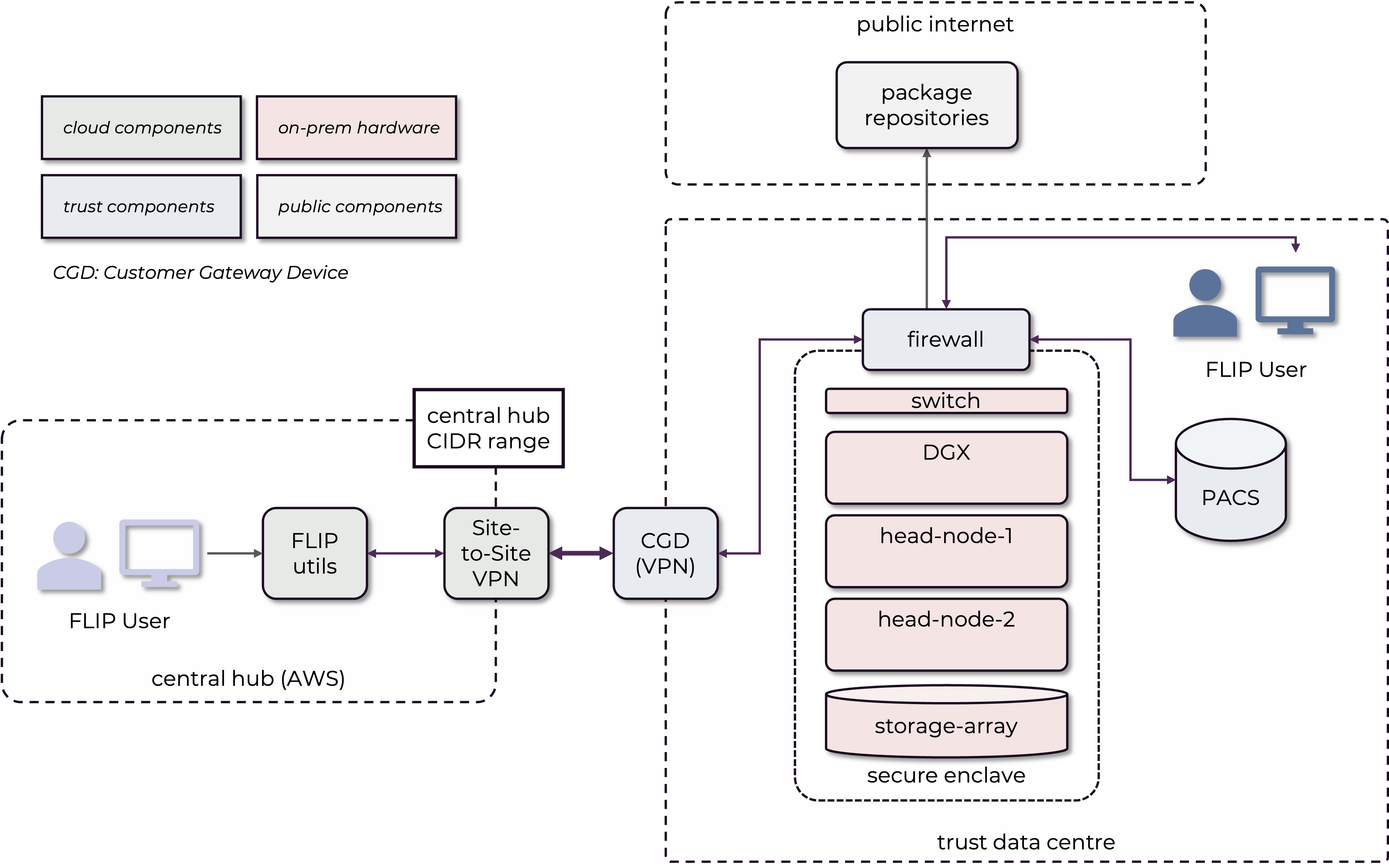
FLIP network architecture.
The following is the list of ports required to be opened for trust-host communication. No inbound
ports are required on trust hosts; everything trust-side is outbound HTTPS to the Central Hub or
to the FL server NLB. Operator access is via AWS Systems Manager Session Manager — port 22 (SSH)
is never opened. Internal trust services (Orthanc, XNAT, trust-api Swagger) are accessible only
via SSM port forwarding (make forward-trust).
Description |
Inbound |
Outbound |
|---|---|---|
DICOM ingestion from local PACS into the trust XNAT |
local PACS DICOM ports |
|
Trust → Central Hub task polling (HTTPS) |
443 |
|
FL client → FL server (via NLB) |
configured |
|
FL client per-run dependency install, Flower backend (HTTPS) |
443 to PyPI ( |
|
Operator access to trust host |
none (SSM Session Manager) |
Backup / Restore
Types of Data
As a system, the FLIP solution handles the following types of data:
Persistent OMOP Common Data Model data, covering demographic, diagnosis and imaging details.
Transient XNAT cached image data, potentially enriched locally with segmentation, labelling, etc., sourced from Trust PACS.
Log files including event logs and other information generated as part of the operation of the system.
Backup
The data partitions for the PostgreSQL (OMOP), XNAT and Loki (log files) instances are all mounted on the dedicated storage array. This is a RAID 6 PNY appliance with high resilience.
Backup scripts will be run daily to backup each data store to a /backups/ directory on the storage appliance. This should be backed up up by the Trust using their specific backup process, ideally overnight.
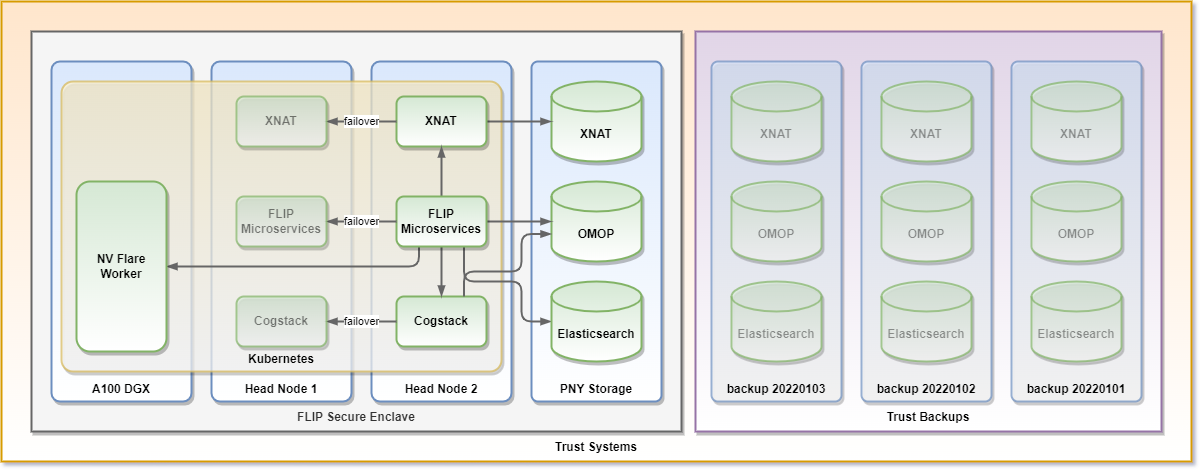
FLIP backups.
Access
Access to FLIP is granted by a FLIP administrator.
Access to FLIP will be reviewed annually, with dormant accounts being removed.
FLIP employs role based access control to permit functionality for accounts, managed through the FLIP API and UI. FLIP currently has three access profiles: Admin, Researcher and Viewer. For full details of permissions assigned to each role, see User Roles.